
- Hospital Furniture
- Neonatal Care Product
- Operating Surgical Tables
- Orthopedic Implants
- Surgical Operating Led Lights
- Orthopedic External Fixators
- Laryngoscopes
- Orthopaedic Power Tools
- Medical Disposables
- Hospital Clothing
- Anaesthesia Products
- Autoclaves & Sterilizers
- Hospital Holloware
- Suction Units
- Rehabilitation Aids
- Stethoscopes
- Anesthesia Machine & Ventilators
- Cold Chain Equipment
- Electro Medical Equipments
- Orthopedic Instruments
- Surgical Operating Led Lights
- Physiotherapy products
China Best Bagasse Sushi Tray Manufacturer or Supplier?
China’s sushi market is expanding, while buyers are asking harder questions about packaging. A tray must protect rice, fish, sauces, and presentation during storage and delivery. It must also withstand moisture without becoming fragile at the counter.
Bagasse Sushi Tray products attract attention because bagasse uses the fibrous residue left after sugarcane processing. FAOSTAT identifies sugarcane as one of the world’s major agricultural crops, creating a substantial stream of plant-based byproduct. Turning that residue into food packaging can support material efficiency, but it does not remove every environmental concern. Manufacturing energy, water use, transport distance, coatings, and end-of-life systems still matter.
The United Nations Environment Programme’s 2023 report, Turning off the Tap, states that global plastic pollution could be reduced by 80% by 2040 through reuse, recycling, and material redesign. Smithers’ packaging outlook also highlights continuing investment in fiber-based and lower-plastic formats. These findings explain why restaurants, wholesalers, and importers are examining Chinese bagasse tray suppliers more closely.
However, “compostable” should never be treated as an automatic guarantee. Local facilities may not accept molded-fiber packaging, especially when it contains barrier coatings or food residue. A reliable China manufacturer should provide material specifications, food-contact documentation, production details, and practical test results. Moisture resistance, stacking strength, heat tolerance, and dimensional consistency deserve direct inspection.
This guide compares Chinese manufacturers and suppliers through those measurable points. Price matters. So do factory experience, quality control, customization capacity, export support, and honest environmental claims. The best choice may not be the cheapest tray. It should be the one that performs reliably from factory floor to sushi counter.
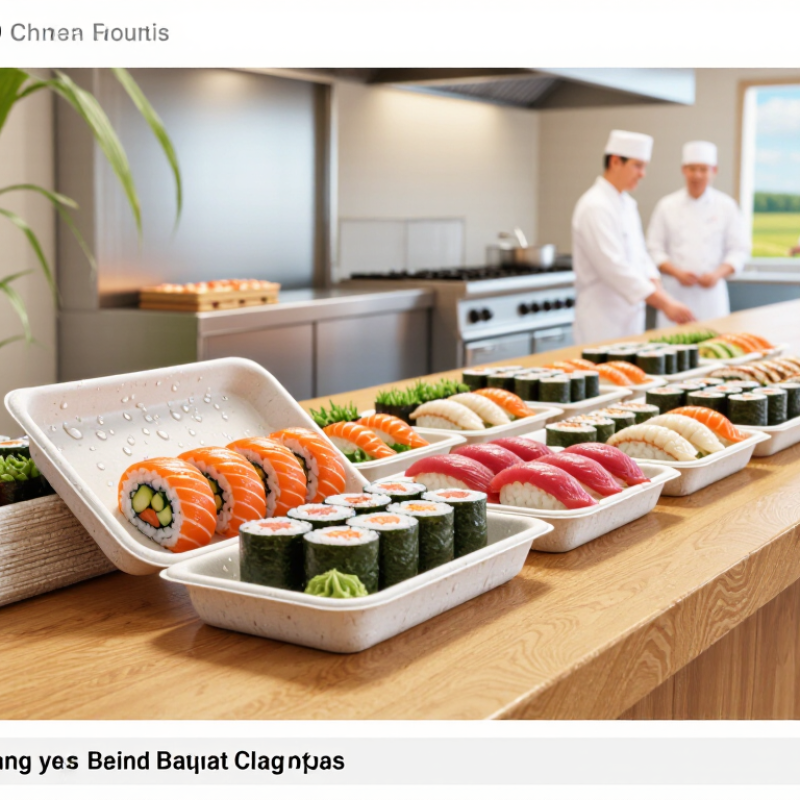
Table of Contents [Hide]
What Is a Bagasse Sushi Tray?
A bagasse sushi tray is a molded food container made from sugarcane fiber. Bagasse is the dry material left after sugarcane juice extraction. Instead of becoming waste, it can be cleaned, pulped, shaped, and dried into a firm tray.
In practical food-service testing, these trays feel light but remain stable under sushi portions. Their textured surface helps prevent sliding during delivery. They can hold rice, fish, vegetables, and small sauce cups when the design is suitable.
However, bagasse is not completely waterproof. Long contact with oily sauces or excess moisture may soften the tray. A proper lid and absorbent liner can improve performance. The tray size also matters. A tight fit protects delicate rolls better than a deep, loose container.
Tips: Check food-contact documentation, molding quality, and leakage resistance before placing large orders. Test the tray with real sushi, chilled ingredients, sauce, and delivery movement. Ask the supplier about fiber sources, thickness, lid compatibility, and storage conditions. Avoid relying only on appearance. A tray may look strong but weaken after refrigeration or extended contact with moisture. Some designs also need better corner strength; this detail is easy to overlook during sampling.


