- Hospital Furniture
- Neonatal Care Product
- Operating Surgical Tables
- Orthopedic Implants
- Surgical Operating Led Lights
- Orthopedic External Fixators
- Laryngoscopes
- Orthopaedic Power Tools
- Medical Disposables
- Hospital Clothing
- Anaesthesia Products
- Autoclaves & Sterilizers
- Hospital Holloware
- Suction Units
- Rehabilitation Aids
- Stethoscopes
- Anesthesia Machine & Ventilators
- Cold Chain Equipment
- Electro Medical Equipments
- Orthopedic Instruments
- Surgical Operating Led Lights
- Physiotherapy products
How to Choose the Right Pharma Filling Machine
Choosing the right Pharma Filling Machine is a process decision, not merely an equipment purchase. A vial line may look impressive under bright factory lights, yet fail when powders cling to the hopper or stopper placement drifts. The machine must match the product, container, filling range, cleanroom design, and validation strategy.
IQVIA’s Global Use of Medicines 2024 report projects global medicine spending will approach $2.3 trillion by 2028. That growth increases pressure on manufacturers to improve speed, flexibility, and supply reliability. FDA process-validation guidance and ISPE’s Baseline Guide Volume 3 both emphasize process understanding, contamination control, and documented performance. These principles should shape every specification.
Quality starts earlier.
Former FDA Center for Drug Evaluation and Research director Dr. Janet Woodcock stated, “Quality cannot be tested into products; it should be built-in or should be by design.” Her comment applies directly to filling equipment. A machine with servo-controlled dosing, restricted-access barriers, automated reject tracking, and cleanable product-contact parts can support that design philosophy. However, automation alone does not guarantee quality. Operator training, environmental monitoring, changeover time, and maintenance access still matter. I may be too optimistic about advanced sensors; poor procedures can defeat excellent hardware.
This guide will examine dosing accuracy, aseptic capability, container compatibility, output requirements, validation evidence, and total ownership cost. It will also question attractive specifications that lack meaningful factory acceptance data. The best Pharma Filling Machine is not always the fastest model. It is the one that performs consistently, can be validated, and remains practical when production conditions change.
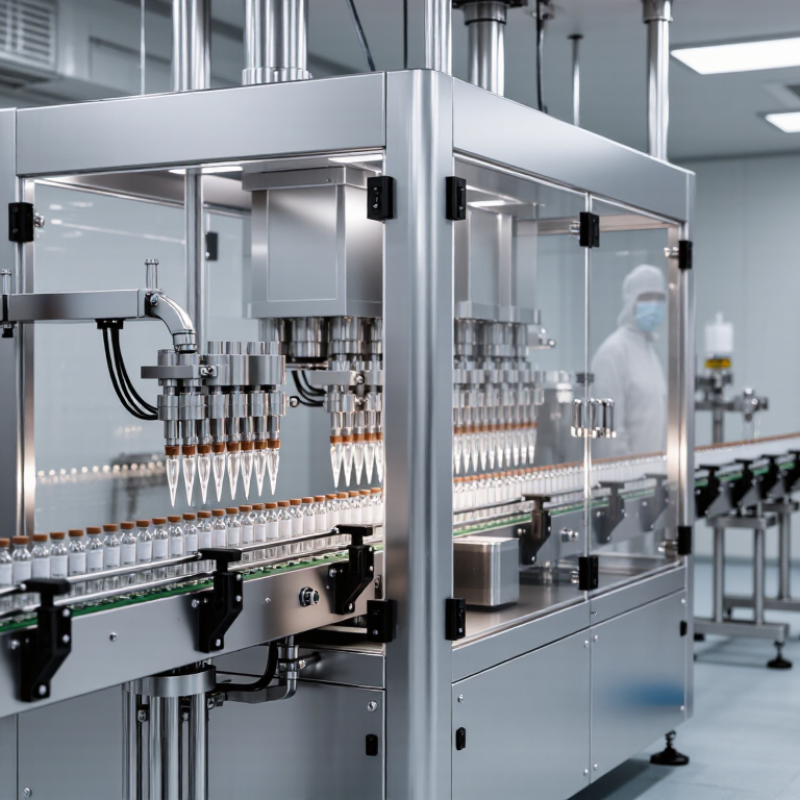
Table of Contents [Hide]
Define the Product and Filling Requirements
Choosing the right pharma filling machine starts with the product, not the equipment catalogue.
Define viscosity, density, foaming, particulates, sterility, and sensitivity to oxygen or light. A 1 mL solution behaves differently from a suspension in a 100 mL bottle. Container material, neck size, closure type, and fill-volume tolerance also matter. Small differences can change dosing accuracy and cleaning performance.
The IQVIA Institute’s Global Use of Medicines 2024 report projects worldwide medicine spending will approach $2.3 trillion by 2028. That growth increases pressure for flexible, reliable filling systems. The WHO Global Vaccine Market Report recorded approximately 13.5 billion vaccine doses supplied in 2021, showing the scale of modern sterile production.
However, high output is not the only target. FDA process-validation guidance stresses control across the full process lifecycle. A machine must therefore match batch size, filling speed, environmental controls, and validation strategy. I would not choose speed before understanding product behavior. That mistake is common, and expensive.
Tips: Record the product temperature during filling. Measure viscosity at production conditions. Test the smallest and largest planned fill volumes. Ask for documented accuracy results using your actual container and formulation. A practical factory trial often reveals issues that specifications hide. Include changeover time, cleaning access, and rejected-container handling in the evaluation. These details seem minor. They rarely are.