
- Hospital Furniture
- Neonatal Care Product
- Operating Surgical Tables
- Orthopedic Implants
- Surgical Operating Led Lights
- Orthopedic External Fixators
- Laryngoscopes
- Orthopaedic Power Tools
- Medical Disposables
- Hospital Clothing
- Anaesthesia Products
- Autoclaves & Sterilizers
- Hospital Holloware
- Suction Units
- Rehabilitation Aids
- Stethoscopes
- Anesthesia Machine & Ventilators
- Cold Chain Equipment
- Electro Medical Equipments
- Orthopedic Instruments
- Surgical Operating Led Lights
- Physiotherapy products
What Is a Non Woven Mask and How Does It Work?
A Non-Woven Mask is made from fibers joined into a fabric without traditional weaving or knitting. Polypropylene is commonly used because it is lightweight, stable, and suitable for layered construction. Unlike ordinary cloth, its surface often looks smooth, yet its internal structure contains many tiny paths.
These layers perform different jobs. The outer layer can resist droplets and moisture. The middle melt-blown layer helps capture small airborne particles through dense fibers and electrostatic effects. The inner layer usually helps manage moisture near the face. It is not a perfect barrier.
Fit matters greatly. Air can leak through gaps around the nose, cheeks, or chin. A mask that feels comfortable may still perform poorly if it hangs loosely. Nose strips, ear loops, and multiple layers can improve practical protection, but design details vary between products. A clear seal is rarely achieved with disposable masks alone.
In everyday use, these masks can reduce exposure to respiratory droplets and help limit the spread of particles from the wearer. Their performance depends on material quality, filtration testing, breathability, and correct wearing habits. Certification labels may provide useful evidence, but they should be checked against reliable standards and product information.
Small details matter. Replace a damaged or damp mask. Avoid touching the filtering surface. Do not assume every non-woven product offers the same protection. Some marketing claims sound impressive, but independent testing may be limited. Understanding how the layers work encourages better choices, while also recognizing the mask’s practical limits.
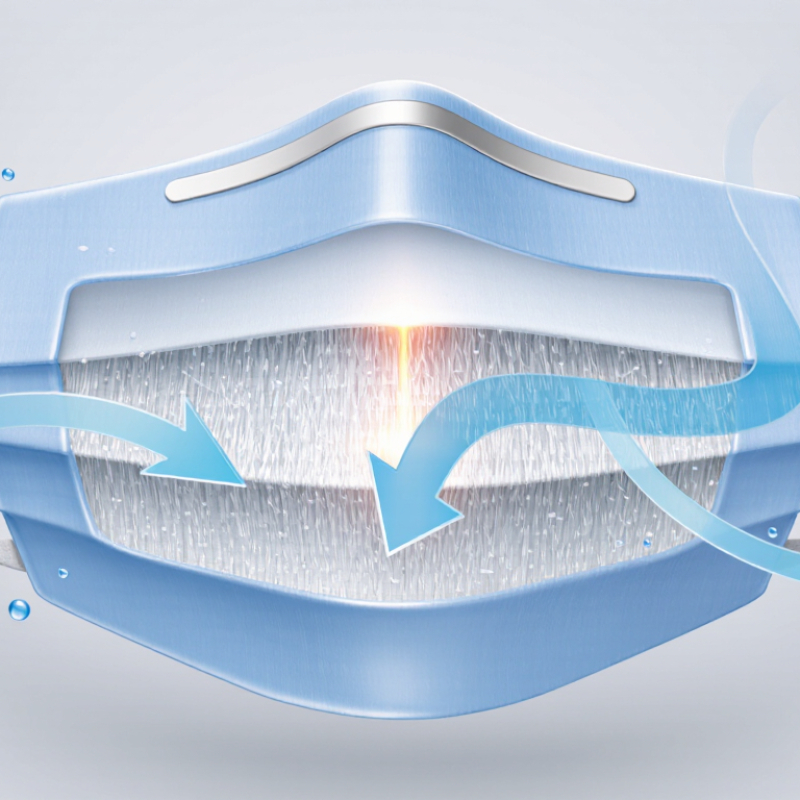
Table of Contents [Hide]
Definition and Basic Structure of a Non-Woven Mask
A non-woven mask is made from fibers bonded together without weaving or knitting. These fibers may be formed from polypropylene, a lightweight thermoplastic widely used in filtration. The material looks like soft paper, but its structure contains a maze of tiny passages. This design helps capture particles while allowing air to pass through.
A typical disposable mask has three layers. The outer layer helps resist droplets. The middle layer provides the main filtration barrier. The inner layer absorbs some moisture from breathing. Many masks also include a flexible nose strip and elastic ear loops. According to ASTM F2100-23, medical mask materials should achieve at least 95% bacterial filtration efficiency at basic performance levels. Higher levels require at least 98% efficiency under the same test method. These figures describe tested materials, not every finished mask.
Fit still matters. A 2024 NIOSH respiratory protection report emphasizes that gaps can reduce real-world protection, even when filter media performs well. Air may move around the cheeks or nose instead of through the filter. That detail is easy to miss. In practical use, a mask should sit smoothly against the face, without crushing the nose or leaving open side gaps. Non-woven technology is effective, but the explanation is not perfect. Comfort, moisture, storage, and manufacturing quality can change performance.
What Is a Non Woven Mask and How Does It Work? - Definition and Basic Structure of a Non-Woven Mask
| Data Dimension | Key Point | Definition, Structure, or Function |
|---|---|---|
| Definition | Non-woven mask | A face mask made from one or more layers of non-woven fabric. Unlike woven fabric, its fibers are bonded mechanically, thermally, or chemically rather than arranged in a regular over-and-under pattern. |
| Common Fiber Materials | Polypropylene and polyester | Polypropylene is widely used because it is lightweight, hydrophobic, and suitable for meltblown and spunbond production. Polyester and other synthetic fibers may also be used in selected mask layers or components. |
| Typical Basic Structure | Three-layer construction | Many disposable medical-style masks use an outer spunbond layer, a middle meltblown filtration layer, and an inner spunbond layer. The number and arrangement of layers can vary according to the mask type and intended use. |
| Outer Layer | Protective and fluid-resistant surface | The outer spunbond layer helps protect the inner layers from larger droplets, splashes, dirt, and abrasion. Its performance depends on the material, surface treatment, and product design. |
| Middle Layer | Primary filtration layer | The middle layer is commonly made from meltblown microfibers. It captures particles through mechanisms including interception, impaction, diffusion, and, in some products, electrostatic attraction. |
| Inner Layer | Comfort and moisture-management layer | The inner layer is designed to contact the face. It helps provide softness, reduce direct contact with the filtration layer, and manage some moisture from breathing and speaking. |
| Filtration Mechanism | Particle capture without sealing every pore | Air passes through spaces between fibers while particles are captured by several physical mechanisms. A filter can allow airflow while reducing the passage of many particles, but no ordinary mask blocks every particle. |
| Electrostatic Effect | Enhanced capture in some filter media | Some meltblown filter layers are electrically charged during manufacturing. The charge can attract certain airborne particles and improve filtration efficiency without requiring an excessively dense material. |
| Fit and Leakage | A close fit improves practical performance | The nose area, ear loops or ties, pleats, and mask shape affect fit. Gaps around the cheeks, nose, or chin can allow air to bypass the filter material and reduce overall protection. |
| Breathability | Balance between filtration and airflow | Breathability is influenced by fiber diameter, layer density, total thickness, electrostatic treatment, and mask area. Higher filtration performance does not automatically indicate better comfort or easier breathing. |
| Moisture Behavior | Performance may change when wet | Moisture from breathing, droplets, or storage conditions can affect comfort and may reduce the performance of some electrostatically charged filter media. A wet, damaged, or visibly soiled mask should be replaced according to its intended use. |
| Typical Form | Pleated or molded design | Pleated masks expand to cover the nose, mouth, and chin. Molded non-woven masks may use shaped layers and an integrated nose area to improve stability and coverage. |
| Supporting Components | Nose strip and attachment system | A flexible nose strip helps reduce gaps around the nose. Ear loops, headbands, or ties hold the mask in place, while edge bonding keeps the layers together. |
| Main Function | Source control and particle reduction | A non-woven mask can reduce the release of respiratory droplets from the wearer and can reduce inhalation of some airborne particles, depending on its filtration material, fit, condition, and use environment. |
| Important Limitation | Not automatically equivalent to a respirator | A loose-fitting disposable mask is not designed to provide the same face seal or tested performance as a properly fitted respirator. Protection depends on the product design, applicable testing, correct use, and fit. |
| Use and Replacement | Follow the product’s intended-use guidance | Replace a disposable mask when it becomes wet, visibly dirty, damaged, difficult to breathe through, or no longer fits securely. Reuse should only occur when the product and relevant guidance specifically allow it. |