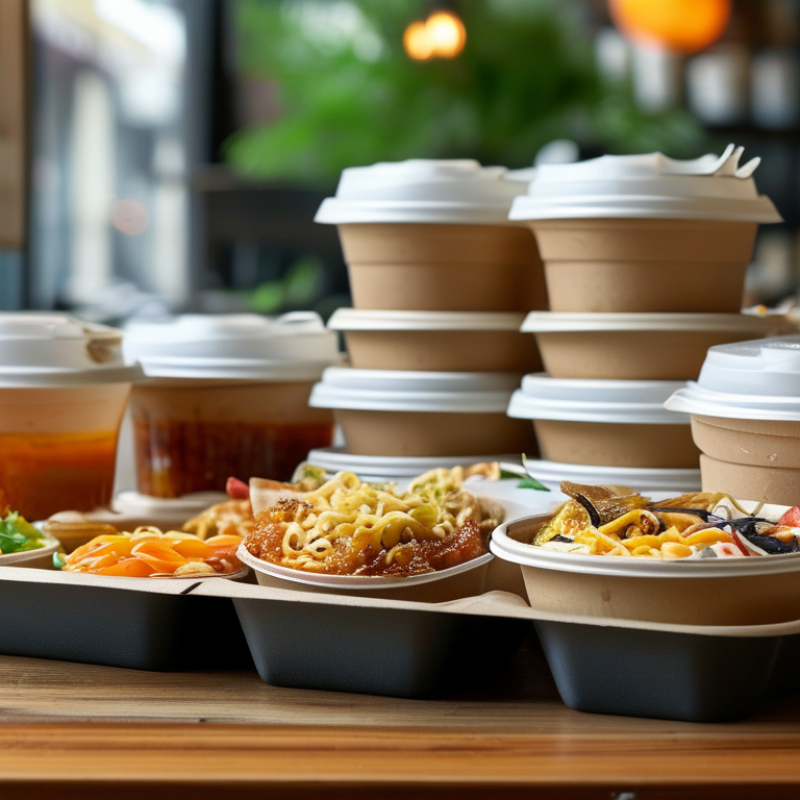
| 1 | Match the container to the food temperature | PP, paperboard with a food-contact lining, or molded fiber | Polypropylene is commonly selected for hot foods because it has a relatively high heat-resistance range among common food containers. Paperboard and molded fiber require a suitable barrier for hot, wet, or oily foods. | Request migration and temperature-use data for the finished container, including the lid, coating, ink, adhesive, and other food-contact components. Do not rely on the resin name alone. | Fiber formats may be recyclable or compostable only where the lining and local collection system allow it. PP is recyclable in some systems, but acceptance varies by country. | Hot noodles, rice meals, soups, curries, and takeaway meals when the supplier confirms the relevant temperature limit. |
| 2 | Choose a material suited to the food chemistry | PP, PET, HDPE, aluminum, or coated paperboard | Acidic, salty, oily, or alcoholic foods can place greater demands on barriers and seals. PET and PP are often used for different food applications, but suitability must be verified for the specific formulation. | Check testing with representative foods or simulants, especially for acidic or fatty foods. Verify that coatings and sealants are approved for the intended food type and contact time. | A single-material structure is generally easier to sort than a paper-plastic laminate or multi-layer package, although local recycling infrastructure remains decisive. | Salads with dressing, tomato-based dishes, fried foods, sauces, desserts, and beverages requiring chemical compatibility. |
| 3 | Prioritize leak resistance and closure design | Snap-fit lids, hinged lids, heat-sealed films, or threaded closures | Leak performance depends on rim geometry, lid fit, seal pressure, stacking, vibration, and temperature changes. A rigid rim and properly matched lid generally improve transport reliability. | Ask for leak, drop, compression, and seal-integrity test methods. Confirm that the sealant and lid materials are food-contact compliant and do not shed particles into the food. | A compatible lid and base made from the same polymer can simplify recycling compared with permanently attached mixed materials. | Soups, gravies, liquid sauces, beverages, delivery orders, and meals transported over longer distances. |
| 4 | Evaluate impact and stacking strength | Rigid PP, PET, HDPE, aluminum, or reinforced fiberboard | Review wall thickness, ribbing, flange strength, compression resistance, and performance after filling. Containers should be tested in realistic stacked and refrigerated or heated conditions. | Physical damage can compromise food safety by exposing food or breaking the closure. Require finished-packaging quality controls, not only raw-material declarations. | Using the minimum material needed for required strength can reduce packaging weight, but excessive lightweighting may increase failure, waste, and product loss. | Meal delivery, catering, airline meals, warehouse storage, and export shipments with repeated handling. |
| 5 | Confirm regulatory documentation for the destination market | Any food-contact material, including plastics, paper, coatings, inks, and adhesives | Documentation should cover the exact finished article and intended conditions of use, not merely a general statement for a similar material. | For the United States, commonly relevant plastic provisions include applicable sections of Title 21 of the Code of Federal Regulations, such as 21 CFR 177.1520 for olefin polymers and 21 CFR 177.1630 for PET. In the European Union, check Regulation (EC) No 1935/2004 and, for plastics, Regulation (EU) No 10/2011. Other markets may apply additional national requirements. | Environmental claims should be supported separately from food-contact compliance. A package can be food-safe without being recyclable or compostable in a particular market. | Cross-border procurement, private-label packaging, imported food service items, and products sold in multiple regulatory regions. |
| 6 | Check reusable-container requirements | Thick-wall PP, stainless steel, glass, or other validated durable formats | Reusable containers need resistance to repeated washing, detergents, heat cycles, impact, staining, and odor absorption. Define a tested service life rather than assuming unlimited reuse. | Request cleaning validation, repeated-use testing, and instructions for maximum temperature, dishwasher use, and inspection. Damaged, crazed, or heavily scratched items may need removal from service. | Reuse can reduce single-use packaging only when return rates, washing systems, transport distances, and replacement rates support the intended life-cycle benefit. | Closed-loop food-service programs, workplace cafeterias, schools, events, and local delivery networks. |
| 7 | Distinguish recyclable from compostable claims | PP, PET, paperboard, molded fiber, or certified compostable polymers | Compostable or fiber containers may require specific moisture, heat, or grease barriers. Confirm that performance remains adequate during the complete serving period. | Food-contact approval and compostability certification are different requirements. In Europe, EN 13432 is a recognized reference for industrial compostability criteria; equivalent local standards may apply elsewhere. | “Compostable” generally does not mean home-compostable or accepted in every municipal system. Recyclability depends on material design, sorting, collection, and reprocessing capacity. | Events, institutional catering, takeaway meals, and markets with a verified local recycling or industrial-composting route. |
| 8 | Assess barrier performance for shelf life | Barrier-coated paperboard, PET, PP, EVOH-containing structures, or aluminum | Oxygen, moisture, grease, aroma, and light barriers affect texture, freshness, and leakage. Barrier performance should be tested under the planned storage temperature and duration. | Ask for declarations covering coatings, adhesives, tie layers, and printing inks. For sensitive foods, review overall migration and relevant specific-migration or extractables data where required. | High-barrier multi-layer structures can be difficult to recycle. Use the simplest structure that meets the required shelf-life and safety target. | Prepared salads, bakery products, chilled meals, sauces, high-fat foods, and products requiring controlled moisture or oxygen exposure. |
| 9 | Verify labeling, traceability, and batch control | All container types and components | Traceable production lots help identify defects such as warped rims, weak seals, delamination, odor transfer, or inconsistent dimensions. | Request a specification sheet, declaration of compliance where applicable, lot identification, manufacturing date, material composition, intended-use conditions, and quality-control records. Food-contact symbols and recycling marks must be used appropriately for the destination market. | Material identification markings can support sorting, but markings do not guarantee that a local facility accepts the package. | International purchasing, regulated food operations, safety audits, recalls, and multi-site food-service networks. |
| 10 | Run practical performance testing before volume purchase | Selected container, lid, seal, label, and secondary packaging as a complete system | Test filled samples for hot-fill or chilled use, stacking, drop impact, vibration, refrigeration, reheating if applicable, and opening by the intended user. Record failure rates and dimensional changes. | Use representative foods and contact times, then compare results with the supplier’s compliance documentation. Confirm that microwave, oven, freezer, or dishwasher claims are specifically supported rather than inferred. | Measure product loss, rejected units, transport damage, and actual disposal routes alongside material weight. Preventing food waste is part of packaging sustainability. | Any global launch, especially where climate, logistics, regulations, serving temperatures, or user behavior differ between markets. |