
- Hospital Furniture
- Neonatal Care Product
- Operating Surgical Tables
- Orthopedic Implants
- Surgical Operating Led Lights
- Orthopedic External Fixators
- Laryngoscopes
- Orthopaedic Power Tools
- Medical Disposables
- Hospital Clothing
- Anaesthesia Products
- Autoclaves & Sterilizers
- Hospital Holloware
- Suction Units
- Rehabilitation Aids
- Stethoscopes
- Anesthesia Machine & Ventilators
- Cold Chain Equipment
- Electro Medical Equipments
- Orthopedic Instruments
- Surgical Operating Led Lights
- Physiotherapy products
Why Source Butterfly Pea Powder for Your Business?
Why Source Butterfly Pea Powder for Your Business?
In practical ingredient sourcing, consistency often matters more than colorful promises. Butterfly Pea Powder can give beverages, desserts, bakery products, and wellness-inspired menus a distinctive blue tone. Its color comes from naturally occurring anthocyanin compounds in butterfly pea flowers. However, the final shade may vary with origin, drying methods, pH, storage, and processing conditions. That detail deserves attention.
A reliable supplier should provide clear product specifications, including botanical identity, mesh size, moisture level, packaging format, and recommended storage conditions. Ask for current certificates of analysis and relevant microbiological testing. Heavy metal, pesticide, and allergen information may also support responsible purchasing decisions. Documentation is not decoration. It helps buyers compare suppliers and reduce avoidable quality risks.
Good sourcing also requires practical testing. Request a sample before placing a large order. Mix a measured amount into water, yogurt, frosting, or a beverage base. Observe color intensity, aroma, solubility, sediment, and batch consistency. Acidic ingredients may shift the blue color toward purple or pink. That visual change can be useful, but it must match your product design.
Price alone can mislead.
A lower quotation may reflect weaker testing, inconsistent materials, or unsuitable packaging. Experienced buyers should evaluate lead times, minimum order quantities, traceability, and communication quality together. No supplier is perfect, and even a well-reviewed product needs verification. By combining laboratory documentation with small-scale trials, businesses can make a more confident decision about sourcing Butterfly Pea Powder for dependable commercial use.
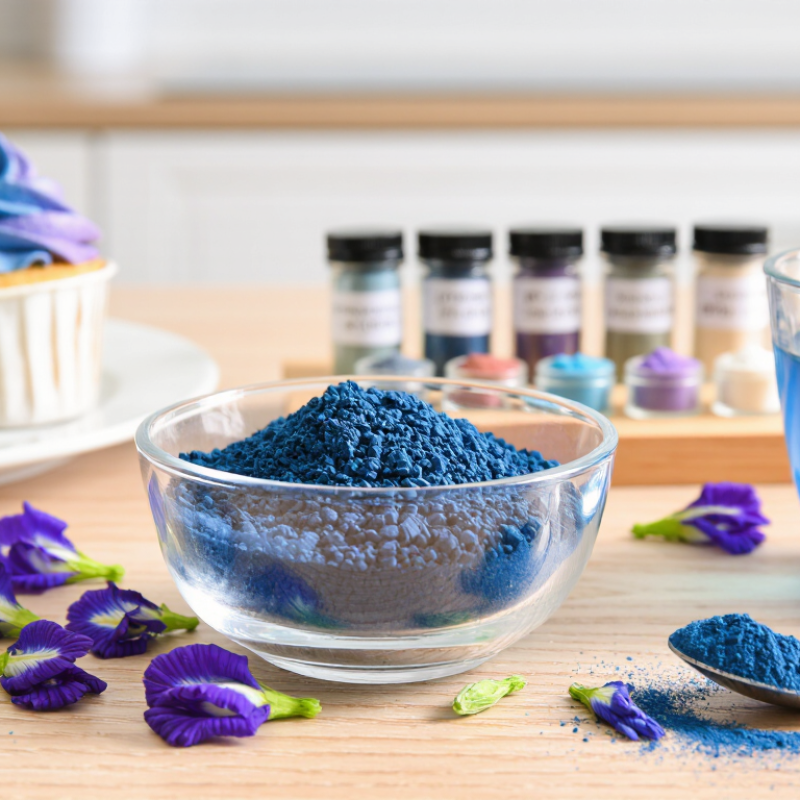
Table of Contents [Hide]
What Is Butterfly Pea Powder and Where Does It Come From?
Butterfly pea powder is made from the dried flowers of Clitoria ternatea, a climbing plant in the pea family. Its vivid blue color comes mainly from anthocyanins, natural pigments that respond to acidity. Add lemon, and the drink may shift toward purple. The effect is striking, but color strength is not fixed. Flower maturity, drying temperature, and storage conditions can all change the final shade.
The plant is associated with tropical Southeast Asia, where it has long appeared in traditional drinks and food preparations. Today, growers also cultivate it in other warm regions with suitable rainfall and soil. After harvest, flowers should be sorted, cleaned, gently dried, and milled into a fine powder. Poor drying can leave excess moisture and weaken aroma. That detail is easy to overlook. The powder is not automatically uniform.
For a business buyer, origin is only one part of a reliable source. Ask for the botanical name, cultivation country, harvest information, processing details, and batch testing. Useful checks include moisture, microbial quality, contaminants, pesticide residues, and color consistency. A certificate alone does not prove every batch is identical. Sampling matters. Suppliers should explain packaging, shelf life, and storage needs clearly. A cool, dry, light-protected environment usually helps preserve quality. Do not judge the ingredient by appearance alone; vivid blue powder may still lack traceability. Conversely, a softer shade is not automatically a defect.